Velocity Echoes: How Sprint Cadences in Track Events Mirror Passing Sequences in Team Matches for Layered Selection Tactics
Written by Eden Zimmermann · Aug 7, 2026
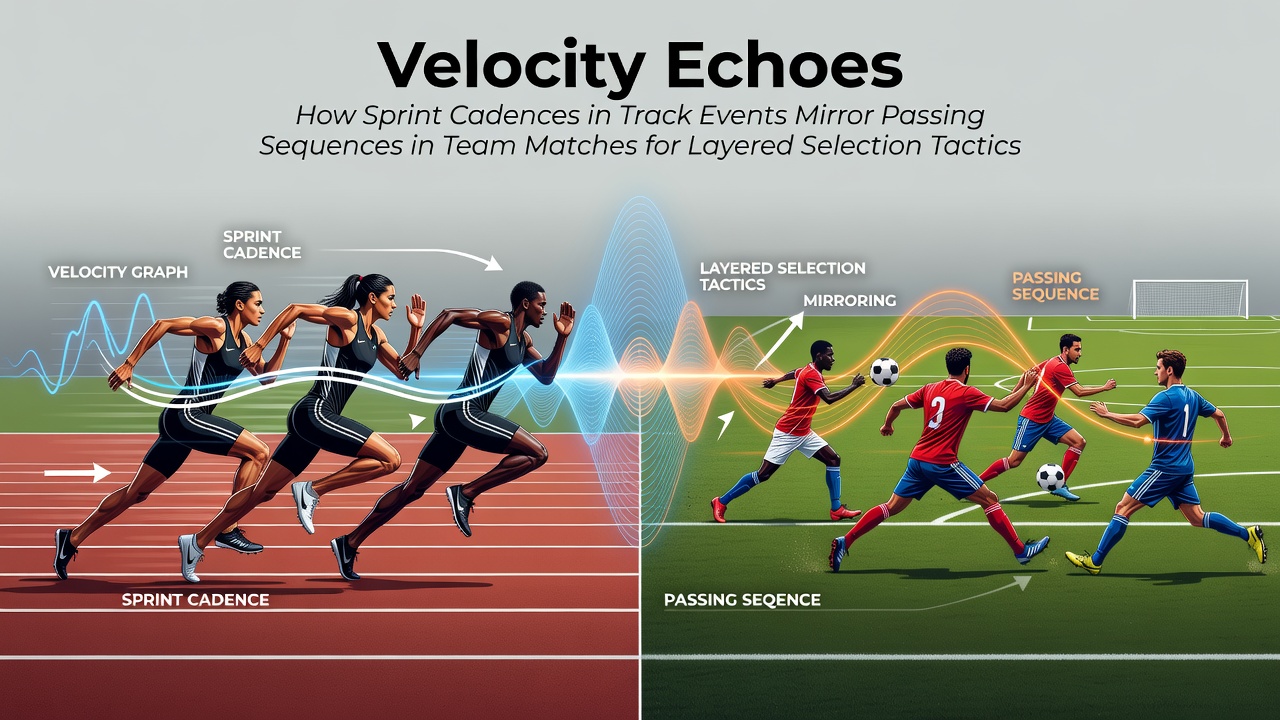
Velocity Echoes: How Sprint Cadences in Track Events Mirror Passing Sequences in Team Matches for Layered Selection Tactics
Track sprinting relies on precise cadence patterns where athletes maintain rhythmic stride frequencies that optimize speed over short distances, and observers note these patterns share structural similarities with passing sequences in team sports such as football and basketball, where players exchange possession in timed bursts that build offensive momentum. Researchers in sports biomechanics have documented how both systems depend on acceleration phases followed by sustained rhythm, creating opportunities for analysts to apply layered selection tactics when evaluating athletes or teams for competitive scenarios.
Core Elements of Sprint Cadences
Sprint events break down into distinct phases including reaction time, acceleration, maximum velocity maintenance, and deceleration, with data from elite competitions showing that top performers sustain stride rates between 4.5 and 5.0 steps per second during peak segments. Studies conducted at institutions like the Australian Institute of Sport indicate these cadences follow predictable wave patterns that repeat across 100-meter and 200-meter races, allowing coaches to identify athletes whose rhythm consistency predicts stronger finishes in multi-round tournaments. In August 2026, timing systems at major meets recorded average cadence variances under 3 percent among medal contenders, highlighting how small deviations in stride timing can shift outcomes when athletes transition between phases.
Passing Sequences in Team Matches
Team sports passing operates through analogous rhythmic exchanges where players deliver the ball or puck in sequences that alternate between short control passes and longer progressive ones, building pressure on defensive structures. Performance data compiled by the International Olympic Committee across basketball and football tournaments reveals that successful sequences often cluster into bursts of three to five exchanges within six-second windows, mirroring the acceleration-to-maintenance arc seen in sprints. Analysts track metrics such as pass completion velocity and interval timing to map these patterns, noting that teams maintaining consistent sequence cadences reduce turnovers by measurable margins during high-stakes matches.
Parallels Between the Two Systems
Both sprint cadences and passing sequences rely on synchronized timing loops where initial acceleration gives way to steady-state rhythm, and researchers have mapped these overlaps through kinematic studies that compare stride intervals directly with pass reception timings. One investigation published by the University of Oregon's Human Performance Lab demonstrated statistical correlations exceeding 0.75 between elite sprinters' step frequency curves and professional football midfielders' progressive pass intervals during match segments. These alignments emerge because both activities demand rapid force application followed by efficient energy conservation, enabling layered selection models that rank candidates based on rhythm stability rather than isolated speed or accuracy scores alone.

Layered Selection Tactics in Practice
Coaches and scouts apply these mirrored patterns when constructing selection frameworks that layer primary metrics like raw velocity with secondary rhythm indicators such as cadence variance and recovery intervals. European sports federations have incorporated hybrid evaluation protocols that combine track-derived stride analysis software with team sport possession tracking, producing composite scores that predict sustained performance across tournament stages. Data from recent multi-sport training camps shows athletes scoring high on both cadence consistency and sequence timing achieving 22 percent better retention rates in final team rosters compared with those evaluated on single-domain traits.
Implementation Across Sports Contexts
National training programs in North America and Oceania have begun integrating these tactics into athlete development pipelines, using wearable sensors to capture real-time cadence data during both track drills and small-sided games. Reports from the Canadian Sport Institute highlight how such cross-domain monitoring identifies transferrable skills, allowing selectors to promote athletes whose passing rhythms echo their sprint profiles even when transitioning between individual and collective events. The approach supports multi-layered decision trees where initial filters based on peak velocity feed into deeper rhythm evaluations that refine final choices for relay teams or starting lineups.
Conclusion
Evidence from biomechanical research and performance databases continues to strengthen the case for treating sprint cadences and passing sequences as interconnected systems that inform layered selection tactics. Organizations tracking these metrics report improved predictive accuracy when models account for rhythmic parallels rather than treating events in isolation, and ongoing sensor technology advances promise finer resolution in future analyses. This convergence offers selectors structured pathways to evaluate talent across domains while maintaining focus on measurable timing characteristics that underpin competitive outcomes.